PHACOEMULSIFICATION (STANDARD)
- Ultrasound breaks up the clouded lens
- The lens is suctioned out
- A new artificial lens is inserted
- The most commonly performed procedure worldwide
- Very safe and proven
Modern procedures and high-quality artificial lenses enable individually tailored treatment today – for the best possible vision quality and more enjoyment of life.
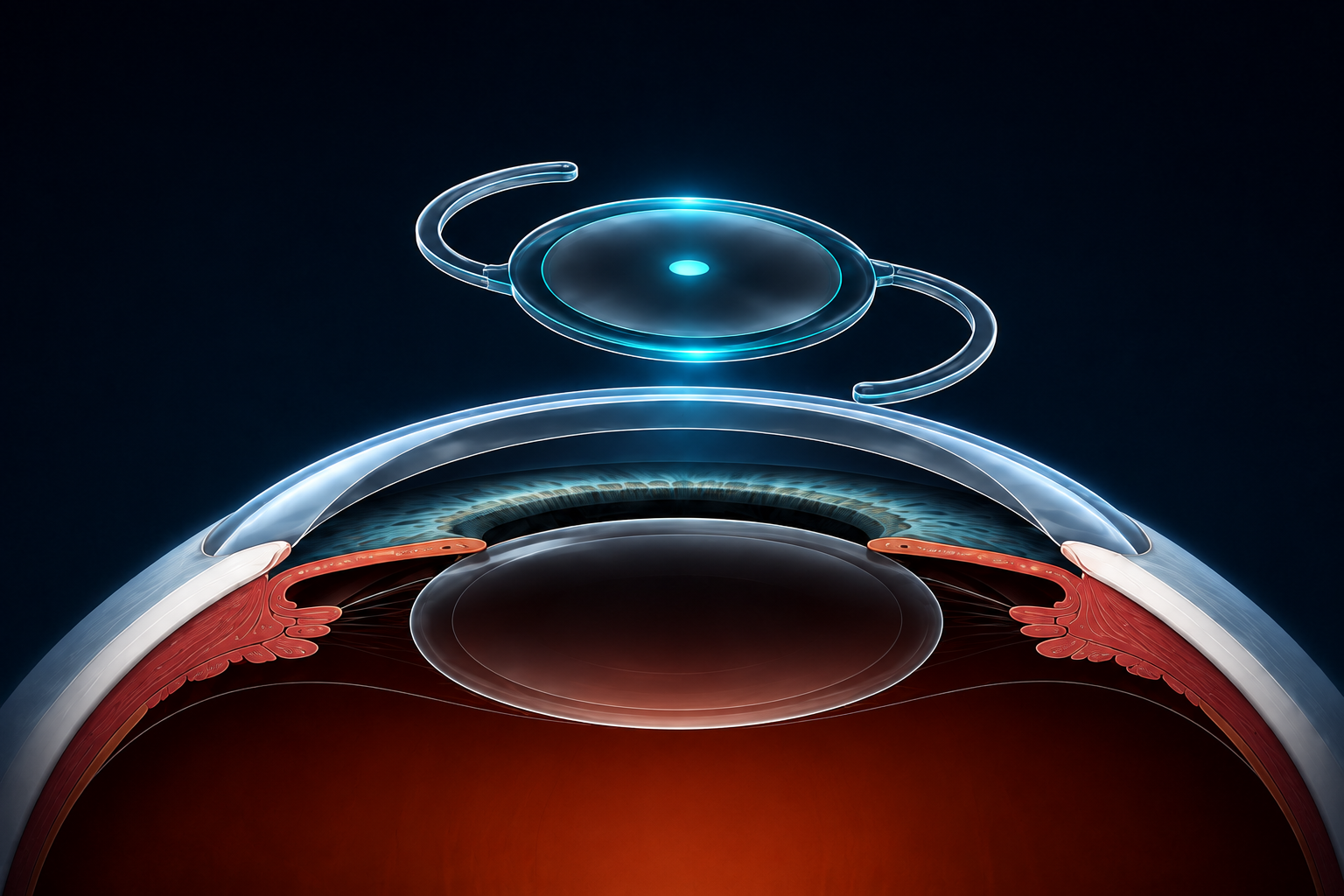
Your eye doctor will advise you on which lens type best suits your eyes and your individual vision needs.
In cataract surgery, the clouded natural lens is removed and replaced with an artificial lens. This is often done using phacoemulsification, in which the lens is broken up and removed with the help of ultrasound. With certain procedures, a femtosecond laser can additionally support individual surgical steps. Which method is used depends on the individual situation and the treatment concept of the respective clinic.
This depends, among other things, on your eye findings, the measurement values, existing eye diseases and your personal vision needs. Depending on the situation, monofocal, EDOF, multifocal or toric lenses may be options, for example. Which lens is medically suitable is assessed individually after a thorough ophthalmological examination.
Depending on the lens type and the individual result, dependence on glasses can be reduced. However, complete freedom from glasses cannot be guaranteed. Even after the operation, glasses may still be required for certain viewing distances or activities.
Monofocal lenses are usually optimised for a specific distance range. EDOF lenses can provide an extended depth of focus, while multifocal lenses can support several vision ranges. The different lens concepts also differ with regard to possible optical side effects and the remaining dependence on glasses. Which solution is suitable must be assessed individually.
A toric artificial lens may be considered if there is suitable astigmatism. Whether it is useful and which power or orientation is required is determined on the basis of precise eye measurements and the individual findings. The lens selection and the desired refractive result should be agreed together with your treating ophthalmologist.
As with any surgical procedure on the eye, risks and complications can occur. These include, for example, inflammation, infection, changes to the retina, deviations from the desired refractive result or problems with the position of the artificial lens. Optical side effects can also occur depending on the lens type used. Your personal risks are discussed before an operation as part of the medical examination and consultation.
The artificial lens is intended to remain in the eye long term and, as a rule, does not need to be exchanged.
Better vision usually as early as the next day.
State-of-the-art technology and experienced surgeons for maximum safety.
Clearer vision, more independence and more enjoyment of life.
Answer a few questions and receive an initial recommendation.
ⓘ Note: This information does not replace a medical examination. Your eye doctor will determine which treatment is medically suitable for you.