Who is it suitable for?
- Short-sightedness (up to approx. -6 D)
- Astigmatism
- Thin cornea
- Contact and combat sports athletes
- People with an increased risk of eye injuries
- Patients who prefer not to have a flap procedure
Laser procedure for correcting certain refractive errors – ideal for thin corneas and for active people.
During surface treatment, the top layer of cells of the cornea is removed. The excimer laser then reshapes the cornea precisely to correct refractive errors. The cornea regenerates on its own over the following days.

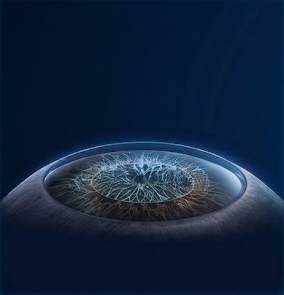 1
1The top layer of the cornea is gently removed.
 2
2The excimer laser reshapes the cornea according to the refractive error.
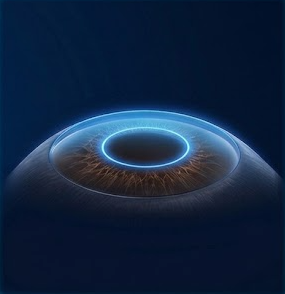 3
3The cornea regenerates on its own over the following days.
The first few days may involve a foreign-body sensation and light sensitivity. Visual acuity stabilises gradually within the first few weeks.
PRK and Trans-PRK are among the oldest and scientifically best-studied laser eye procedures, with long-proven results.
Vor der Behandlung wird das Auge mit Augentropfen örtlich betäubt. Während des Eingriffs werden daher in der Regel keine oder nur geringe Beschwerden wahrgenommen. In den ersten Tagen danach können jedoch Schmerzen, Brennen, Fremdkörpergefühl und Lichtempfindlichkeit auftreten. Die individuelle Nachsorge und Schmerzbehandlung erfolgt durch die behandelnde Klinik.
The top layer of the cornea regenerates within the first few days after the treatment. Visual acuity may fluctuate at first and stabilises gradually. How quickly recovery progresses varies individually and is assessed during follow-up examinations.
Depending on the healing process and your occupation, a break from work of several days may be necessary. Screen-based work in particular can be more demanding at first. When you can resume your professional activity should be agreed individually with the treating clinic.
Not every patient is suitable for PRK or Trans-PRK. Certain conditions or irregularities of the cornea and ocular surface, as well as other individual factors, may speak against treatment. Whether the procedure is medically suitable can only be assessed after a thorough ophthalmological pre-examination.
The change to the cornea made by the laser is permanent. Nevertheless, visual strength and vision can change over the course of life. In individual cases, a new spectacle correction or further treatment may become necessary.
When sporting activities can be resumed depends on the healing process and the sport in question. Contact with the body, water, dust or an increased risk of injury may require a longer break. The treating clinic will give you individual recommendations on this.
Hinweis: Diese Informationen ersetzen keine ärztliche Untersuchung. Ihre Augenärztin oder Ihr Augenarzt prüft, ob eine Oberflächenbehandlung (PRK / Trans-PRK) medizinisch für Sie geeignet ist.
ⓘ Note: This information does not replace a medical examination. Your eye doctor will determine which treatment is medically suitable for you.