WHO IS IT SUITABLE FOR?
- The desire for as complete freedom from glasses as possible
- Frequent reading and working at close range
- Smartphone and tablet users
- Travelling, sport and active people
- Patients with high demands on their vision quality
Multifocal intraocular lenses (MFL) enable sharp vision at near, intermediate and distance. So you enjoy more freedom in everyday life – without constantly having to reach for your glasses.
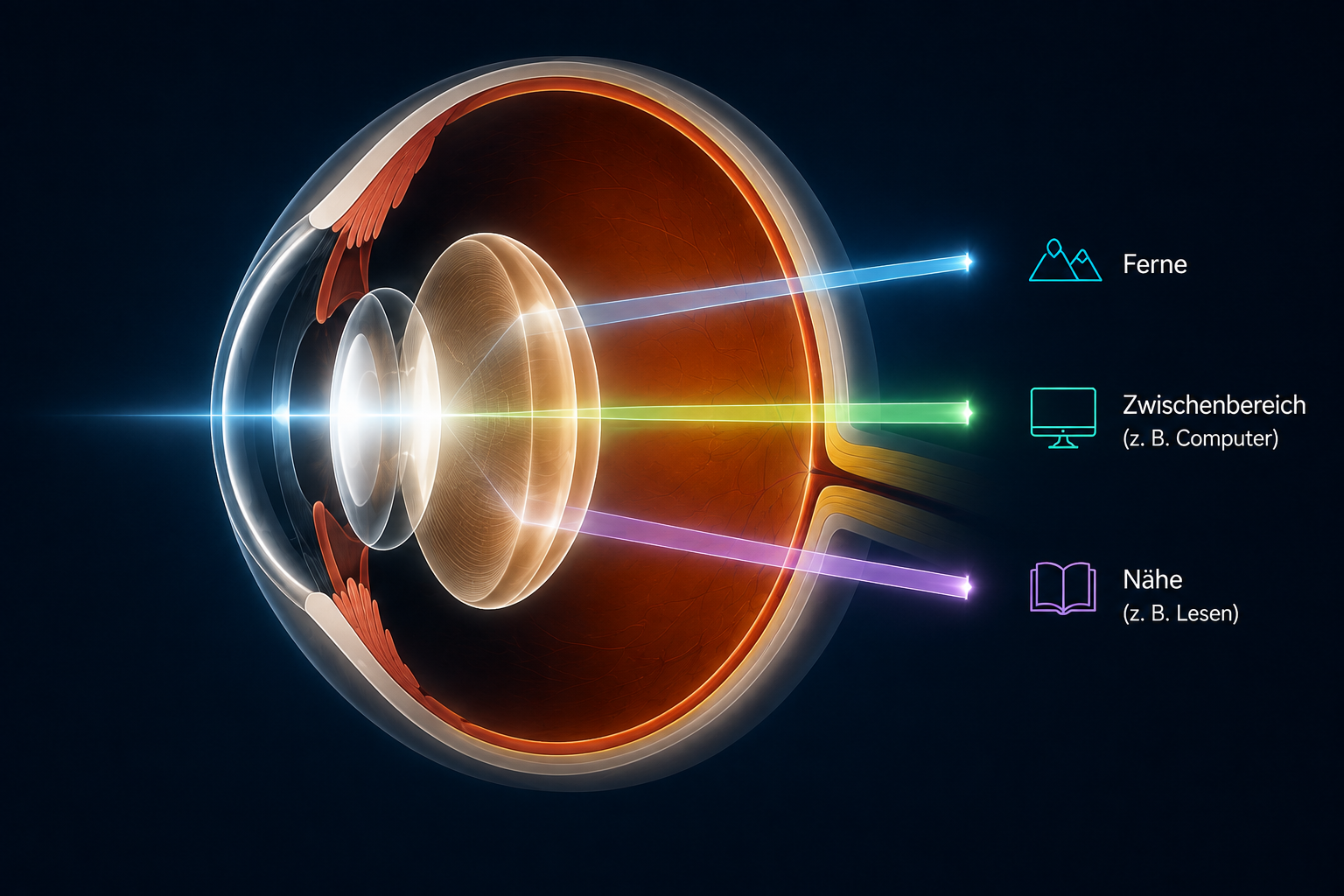
Multifocal lenses can support vision at several distances – for more independence in everyday life. Whether and to what extent you need glasses after the procedure depends on your individual eye findings and expectations.
MFLs distribute light via several optical zones or ring structures so that it is focused at different distances.
Depending on your lifestyle, viewing habits and eye findings, we select the right multifocal lens for you.
for the highest vision quality
for astigmatism
for maximum satisfaction
Multifocal intraocular lenses may be suitable for people who would like to reduce their dependence on glasses for various distances. Whether such a lens is suitable depends, among other things, on the eye findings, viewing habits and personal expectations. Individual suitability is assessed during a thorough ophthalmological examination.
After implantation, an adaptation phase may be necessary. The visual system must adapt to the different focus areas and the changed visual impressions. How quickly and to what extent this adaptation takes place varies individually and can take several weeks or longer.
With multifocal lenses, optical phenomena such as halos, glare or light rings can occur, particularly at dusk or in the dark. Contrast vision can also be reduced compared with monofocal care. How strongly these effects are perceived and whether they become less disturbing over time varies individually. In addition, the general risks of eye surgery exist, about which you are medically informed before the procedure.
Multifocal lenses can reduce dependence on glasses for distance, intermediate zone and near. However, how great the actually achieved independence from glasses is depends, among other things, on the lens type used, the individual eye findings and the surgical result. Complete freedom from glasses cannot be guaranteed; glasses may still be required for certain activities.
Vision at dusk and in the dark can differ from that with a monofocal lens. In particular, light sources can be perceived as halos, glare or light rings, and contrast vision can be impaired. This can be relevant, for example, when driving at night. How pronounced these perceptions are varies individually and should be taken into account when selecting the lens type.
Our lens specialist thoroughly examines your eyes and recommends the optimal solution for your needs.
ⓘ Note: This information does not replace a medical examination. Your eye doctor will determine which treatment is medically suitable for you.