WHO IS IT SUITABLE FOR?
- Patients with cataracts
- People who prefer a fixed vision focus
- People for whom glasses for other distances are acceptable
- People with high demands on contrast vision and image quality
Clear vision at one fixed distance – proven standard care in cataract surgery.
Monofocal intraocular lenses (IOL) have a fixed focus and are frequently used as part of cataract surgery. Depending on the individual target planning, the focus can be placed, for example, on good distance or near vision. Glasses may still be required for other distances.
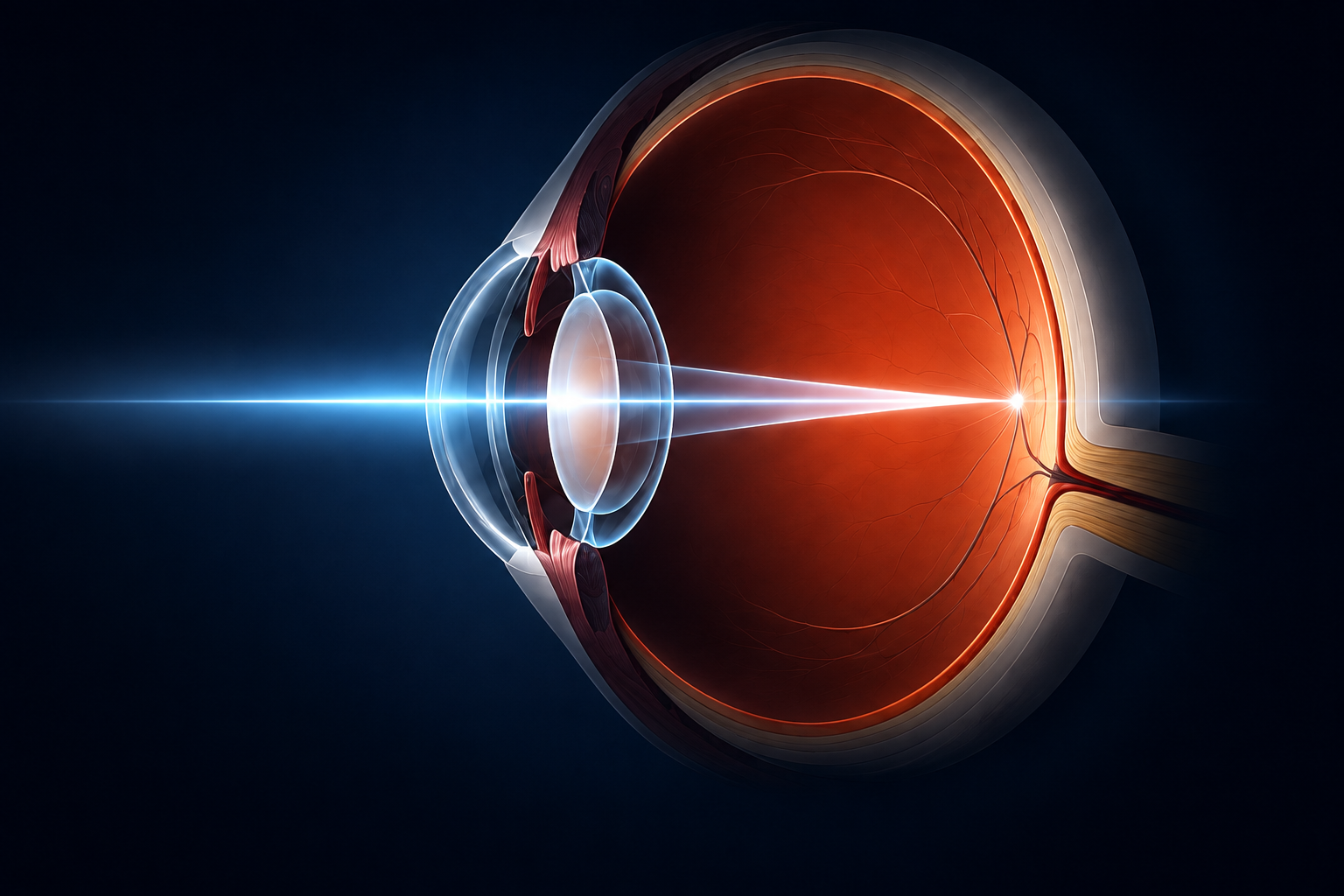
Monofocal lenses have a fixed focal point and offer you razor-sharp vision at exactly one distance.
The choice of the appropriate IOL is made individually and in consultation with your eye doctor – based on your eye values and personal needs.
A monofocal intraocular lens (IOL) is an artificial lens with a fixed focus range. In cataract surgery, for example, it replaces the natural lens of the eye. Depending on individual planning, the vision focus can be chosen for distance or near, for example. Glasses may still be required for other distances.
This depends on the chosen target refraction, the individual conditions of the eye and the actually achieved result. If distance is chosen as the vision focus, for example, glasses are still required for reading and often also for the intermediate zone. Additional spectacle correction may also be necessary for the chosen target distance.
Before the operation, the eyes are carefully measured. On the basis of these measurements as well as your individual viewing habits and needs, a target refraction is agreed together with your treating ophthalmologist. The calculation enables planning as accurate as possible, but the actually achieved result can deviate from the desired target refraction.
As with any surgical procedure on the eye, cataract surgery can also involve risks and complications. These include, among other things, inflammation or infection, temporary changes in intraocular pressure, retinal or corneal complications and deviations from the desired refractive result. In some cases, further treatment or procedures may be required. Your individual risks are discussed as part of the medical pre-examination and consultation.
Take our free lens advisor and find the optimal solution for your eyes.
ⓘ Note: This information does not replace a medical examination. Your eye doctor will determine which treatment is medically suitable for you.